
5 Giving Tuesday Facts to Know and 1,000,000 Questions to Ask
Updated December 2, 2025
This post is inspired by a recent webinar hosted by raisin and Double the Donation, wherein fundraising experts discussed key strategies for maximizing Giving Tuesday impact. Be sure to check out the webinar recap to dive deeper into the insights and discover even more ways to optimize your Giving Tuesday campaign.
Understanding the facts behind Giving Tuesday can provide nonprofits with valuable insights into donor behaviour and help guide the strategy for making the most of this day. Here are five Giving Tuesday facts to know, along with the million-dollar questions nonprofits need to ask to improve their impact and increase donations.
Here’s what we’ll cover:
- Fact #1: Individual donors accounted for $1.5 trillion in 2024.
- Fact #2: People really are more generous on Giving Tuesday.
- Fact #3: Most donations are made between 11 am and 12 pm, followed by 4 to 5 pm.
- Fact #4: 20% of Giving Tuesday donors from 2023 returned in ‘24.
- Fact #5: Gen Z is leading the way with engagement (but is still under-engaged).
- And more!
Let’s begin!
Fact #1: Individual donors accounted for $1.5 trillion in 2024.
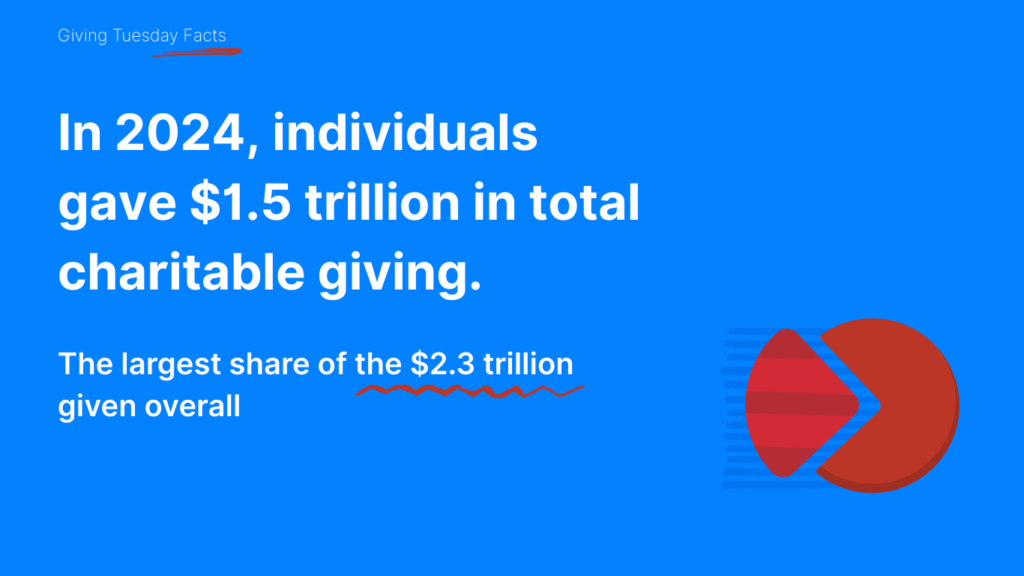
In 2024, individual donations accounted for a staggering $1.5 trillion of the total $2.3 trillion in total charitable giving. This highlights the immense role that individual donors play in nonprofit funding. On Giving Tuesday, these individuals are more likely to give to causes that resonate with them, especially during this time of year when charitable giving is front of mind.
Did You Know? Individual donations make up the largest share of charitable giving. While corporate and foundation contributions also play a key role, individual donors are the most significant source of Giving Tuesday funds for nonprofits across the globe. However, if your organization hasn’t already, now is the time to focus on diversifying your revenue streams and tapping into other sources.
The easiest way to benefit from corporate giving on Giving Tuesday? Employee matching gifts! These are corporate donation programs in which businesses match donations made by their employees. They represent an underutilized opportunity for many organizations. Understanding how to leverage corporate matching alongside individual donations can further amplify your impact.
Fact #2: People really are more generous on Giving Tuesday.
One of the most powerful aspects of Giving Tuesday is the generosity that people display. After a season of consumption during Black Friday and Cyber Monday, Giving Tuesday serves as a charitable reset.
The result? raisin data demonstrates that people are more likely to give on this day than at just about any other time of the year. When comparing Giving Tuesday to annual averages, we see increases in both the total amount donated and the number of donors. Many organizations even report that their donor base grows substantially on this day.
Quick Tip: Nonprofits should take advantage of this increased generosity to drive participation in matching gift programs. For the best results, make sure your Giving Tuesday campaigns are optimized to encourage matching gifts. Highlight these programs in your communication and let donors know how they can double or even triple the impact of their donation without giving more.
Fact #3: Most donations are made between 11 am and 12 pm, followed by 4 to 5 pm.
Timing is crucial on Giving Tuesday. Research shows that the most generous times for giving occur between 11 AM and 12 PM, followed closely by 4 to 5 PM. The largest number of donations (peak volume) was made between 6 and 7 PM. This data should guide your nonprofit’s campaign strategy, particularly when sending out emails or social media reminders. If you know that these are peak giving times, aim to schedule your outreach around these key hours to maximize donor engagement.
Additionally, remember that timing doesn’t just affect donations; it also influences the success of your matching gift reminders. Once a donor gives, regardless of the time of day, sending an immediate reminder about matching opportunities can be the key to securing corporate funds and keeping them engaged in your nonprofit’s mission.
Fact #4: 20% of Giving Tuesday donors from 2023 returned in ‘24.
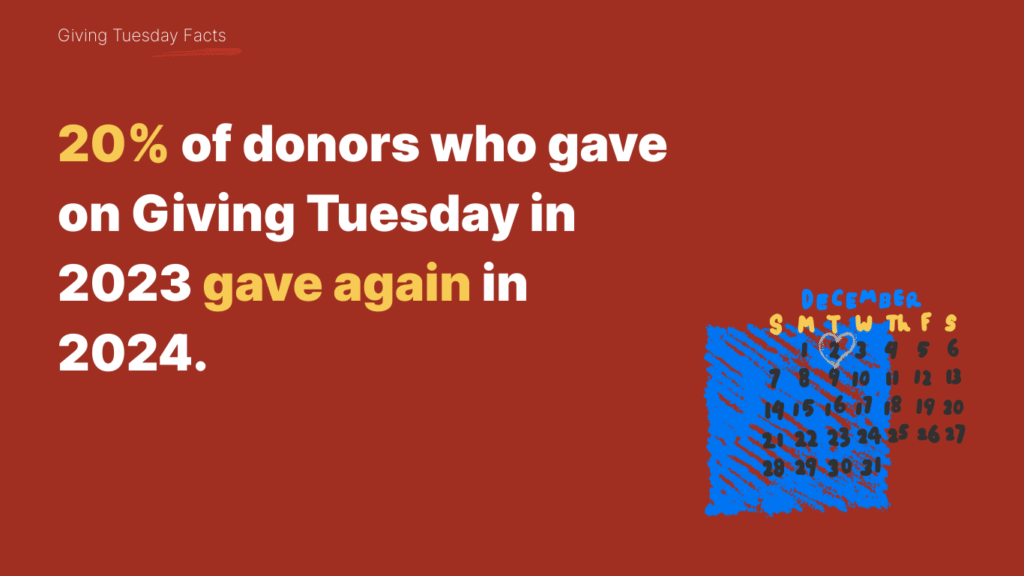
Donor retention is a vital component of any nonprofit’s fundraising strategy. In fact, 20% of the donors who contributed on Giving Tuesday in 2023 returned to donate again in 2024. This highlights the importance of donor stewardship and shows that a one-time event like Giving Tuesday can lead to lasting relationships with supporters.
For nonprofits, the key takeaway is to stay engaged with your donors throughout the year. Following up with personalized thank-you emails, sharing updates on how their donations made a difference, and offering opportunities for future involvement are all strategies that can help increase retention.
Quick Tip: Consider integrating matching gifts into your stewardship plan. When donors are reminded about matching gift opportunities, they’re more likely to return and give again, especially if they feel that their contributions are having an outsized impact.
Fact #5: Gen Z is leading the way with engagement (but is still under-engaged).
The youngest working generation, Gen Z, is showing strong engagement with charitable causes. However, despite their enthusiasm, they are still under-engaged compared to older generations. Many Gen Z individuals are passionate about social justice and community impact, but they may not yet be fully aware of how they can maximize their contributions through workplace giving programs like matching gifts.
To effectively engage Gen Z, consider making the donation process more accessible and offering clear communication about how their contributions can be amplified through employer matching. Nonprofits can also tap into social media and other digital-first engagement channels to reach this demographic, promoting ways they can get involved and make a difference.
Did You Know? Gen Z is more likely to engage with causes that align with their values. If your nonprofit hasn’t yet adapted to engage this generation, now is the time to start crafting campaigns that resonate with their sense of purpose.
Nonprofits’ Questions about Effective Giving Tuesday Practices
After reviewing the essential Giving Tuesday facts, it’s time to explore the most common questions nonprofits face when planning and executing their giving day campaigns.
Is Giving Tuesday giving adjusted for different time zones?
Yes, your Giving Tuesday appeals can be adjusted for time zones within your fundraising or email automation platform. This allows your organization to send targeted messages at optimal times, based on your donors’ time zones, and to engage them with the right message at the right time.
Can you set up dedicated automations for specific days, like Giving Tuesday?
Yes! Setting up dedicated email automations for Giving Tuesday lets you create targeted, time-sensitive messages that can boost engagement and donations.
With Double the Donation’s platform, for example, you can enable a year-end email stream that triggers an additional matching gift reminder on a set day without disrupting your regularly scheduled automations.
Does including a donation form field for gift-matching slow things down or harm conversions?
Including a gift-matching option doesn’t slow things down as long as it’s implemented smoothly as an optional form field rather than a required input.
In fact, data shows that when donors are aware they qualify for a match, they’re more likely to give, and to give more, during the donation process.
What is the biggest influencer for raising larger gifts at year-end?
Corporate matching gifts are one of the most significant influences on larger year-end donations. Donors who are aware of the matching opportunities are more likely to increase their contributions. Additionally, those giving via desktop are likely to contribute more than individuals using their mobile devices.
What does the data say about subject lines?
Short, clear, and personalized subject lines (around 6-10 words) tend to perform the best. Including the donor’s name and incorporating a sense of urgency (e.g., “Daniel, give TODAY to contribute to our Giving Tuesday campaign!”) can significantly improve your open rates.
When promoting campaigns to net new donors, what are some of the best channels to use?
According to raisin Software’s data, the most successful channels for reaching new donors are direct traffic (people visiting your donation page) and referrals. Organic search also drives significant traffic, while social media tends to be less effective for new donor acquisition.
How can we export the source medium alongside donor data?
By integrating tools like Google Analytics with your nonprofit fundraising platform, you can track the source of each donation (whether from an email campaign, social media, or a direct referral) to gain valuable insights into your most effective channels.
Should we create a new dedicated campaign or modify our regular donation page?
Both approaches are beneficial. While your main donation page should highlight your Giving Tuesday efforts, it’s also a good idea to create a dedicated campaign page with a fundraising thermometer and clear impact statements to drive additional engagement.
By understanding these five Giving Tuesday facts and addressing key questions about effective practices, nonprofits can significantly increase their chances of a successful campaign. Leveraging matching gift opportunities, engaging new donors, and maximizing timing are just a few ways to elevate your Giving Tuesday strategy. Good luck!
This post is inspired by a recent webinar hosted by raisin and Double the Donation. To learn more, check out the full recap of the presentation.