
What does a great nonprofit organization look like? And how do you get there?
These are important, but difficult, questions to answer.
Every NFP is at its own stage of maturity. Growth, ambition and scale are as diverse as the causes these organizations support and the communities behind them.
One of the benefits of having over a decade of fundraising data across hundreds of successful orgs is that we can step back, compare, learn and look for patterns that may help a nonprofit think about the path they are on today.
So, we did exactly that.
At a glance
When we looked across four years of fundraising performance, stronger-performing organizations consistently did a better job connecting their mission, fundraising messaging, digital experience, donor engagement and internal execution. The common thread wasn't one tactic. It was a more connected supporter journey.
Looking beyond fundraising growth alone
For this study, we looked at 100 nonprofit organizations over a four-year period and took a broader view of fundraising performance. Rather than looking only at how much fundraising revenue grew, we considered both:
Top-line fundraising growth: Is the organization raising more?
Fundraising efficiency: How does that growth compare with the growth in fundraising expenses?
For example, an organization may have doubled fundraising revenue over four years. That’s obviously positive. But if the costs required to generate that revenue tripled during the same period, it tells a different story.
The results showed a wide dispersion in fundraising performance.
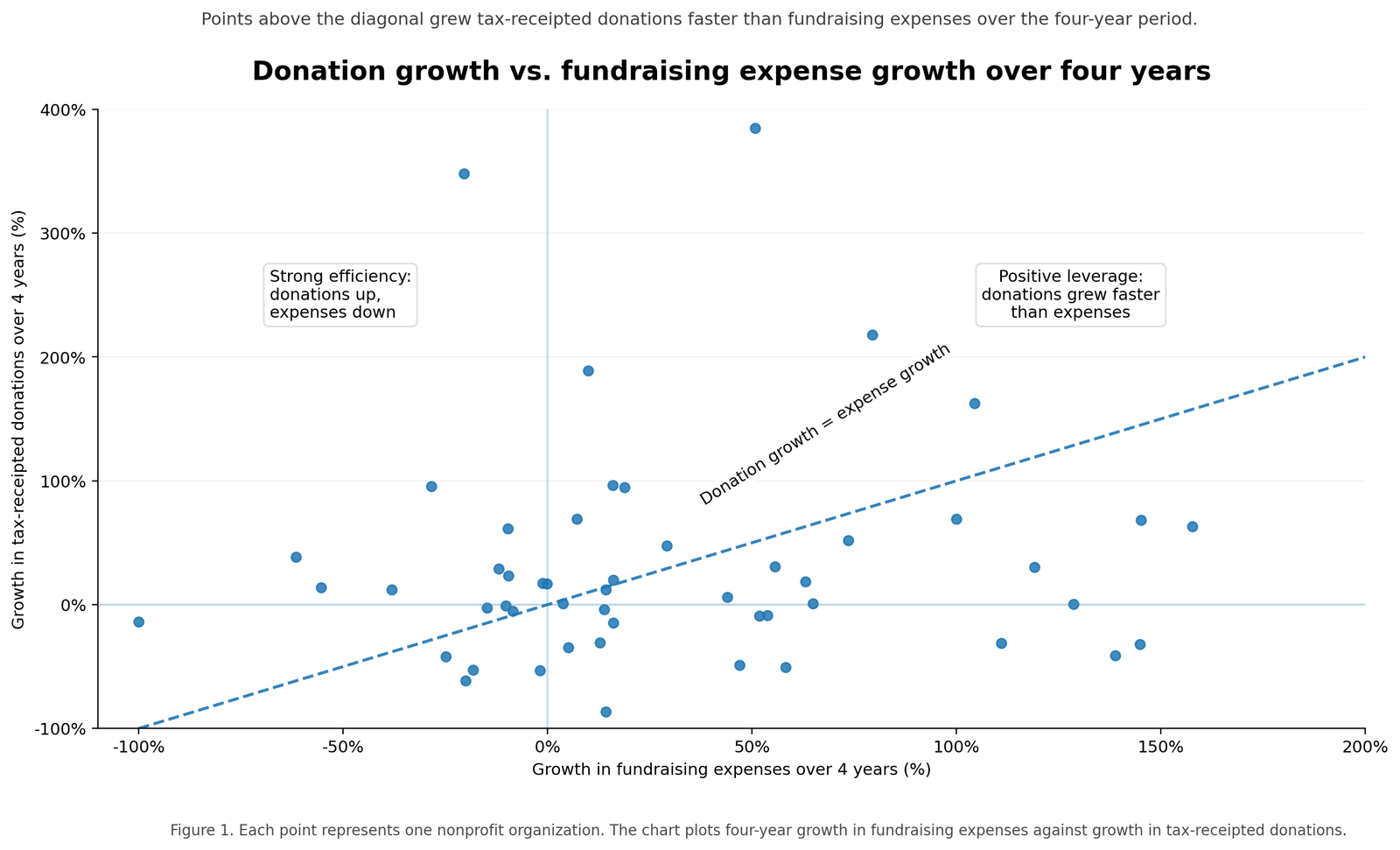
There are organizations with very different levels of fundraising growth and very different changes in the expenses required to support it. What becomes interesting is the relationship between the two.
If you can grow receipted fundraising revenue faster than your fundraising expenses, you are improving fundraising efficiency. And if you're doing that while also growing overall fundraising revenue, you're in pretty rarified air.
A simple way to think about it is:
Fundraising Efficiency + Top-Line Fundraising Growth = Overall Fundraising Effectiveness
So, what were the top performers doing differently?
We ranked organizations from the top quartile, the highest-performing 25%, to the bottom quartile. At first, we didn’t see an obvious pattern. The organizations represented:
Different types of causes
Different sizes
Different geographies
Different fundraising strategies
In fact, the only thing they all had in common was that they were raisin clients. This is where it got really interesting. We decided to look at a deeper set of data to understand which features and capabilities within our product distinguished the top-quartile organizations from those in the bottom quartile.
Part of the reason for doing this was practical. If we could better understand how successful organizations were using raisin, we could use those insights to reinforce the parts of our platform that support stronger fundraising performance.
You can see more about how some of that thinking is influencing our product direction in our roadmap webinar.
Then we looked at the question from a completely different perspective. We used AI-assisted analysis to review fundraising approaches, donor-facing communications and digital presence of the top and bottom quartiles and look for common themes.
The differences were surprisingly clear.
This doesn’t mean addressing these areas will make an organization a top-quartile performer in four years. Nor does the analysis prove that any one of these practices causes better fundraising performance. But these characteristics appeared consistently enough among stronger performers that they’re worth paying attention to. And, in many cases, they’re things nonprofits can start assessing today.
1. Mission Statements & Values
Organizations in the top performance tier tended to articulate their mission and purpose clearly and specifically. Their messaging often emphasized community impact, improved healthcare outcomes, and tangible benefits such as programs, facilities and equipment. In other words, it was easier to understand what the organization stood for and what a donor’s support could help make possible.
Organizations in the lower performance tier also communicated purpose and community benefit, but the messaging tended to be broader and less specific. The difference wasn’t necessarily whether they had a mission. It was how clearly that mission translated into something meaningful for the supporter.
2. Fundraising Messaging
Top-quartile organizations tended to feature strong calls to action throughout their websites and communications. Their fundraising messaging was visible, clear and connected to the impact supporters could help create.
Lower-quartile organizations also included donation messaging and appeals, but these tended to be less prominent, less frequent or less integrated into the broader story being told. In some cases, the messaging also appeared less emotionally compelling.
Again, the difference wasn't simply whether there was a Donate button. It was whether the journey from understanding the cause to knowing how to participate felt clear.
3. Donor Engagement
Higher-performing organizations tended to offer more structured opportunities for donors to remain involved. These included recurring giving programs, donor recognition programs, and initiatives that helped supporters remain connected to the impact of their contributions.
Organizations in the lower quartile often had donor programs too, but they tended to be less structured or less prominently communicated. This is an important distinction. A donation is one moment. The donor relationship can be much longer. The stronger-performing organizations appeared more consistently prepared for what happened after that first action.
4. Transparency & Financial Information
Top-quartile organizations tended to demonstrate a strong commitment to transparency and accountability. This often included publicly available financial statements, annual reports, impact reporting and adherence to recognized fundraising and governance standards. Those things help answer some very basic questions supporters have:
Can I trust this organization?
Where is my money going?
Is my support actually making a difference?
Transparency among lower-quartile organizations was more variable. Some provided detailed financial and impact reporting, while others provided much less.
5. Event Promotion & Communications
Higher-performing organizations regularly promoted fundraising events, campaigns, and success stories through their websites, newsletters, and social media channels. The ongoing communication didn’t just promote the next fundraising ask. It helped demonstrate activity, impact and ways for supporters to participate.
Organizations in the lower quartile also promoted events and campaigns, but often less frequently, detail or storytelling.
6. Technology & Digital Presence
Top-tier organizations generally demonstrated a stronger digital presence. That included modern websites, online donation platforms, email communications, social media activity and other digital tools that made it easier for supporters to engage.
There was greater variation among lower-quartile organizations. Some had less-developed online donation functionality, less frequent digital communication or social media activity that made participation more difficult.
The interesting point here isn’t that top performers had more technology. It’s that their digital tools appeared more consistently connected to the fundraising experience they were trying to create.
7. Sentiment Orientation
We also saw differences in the language organizations used.
Among top-quartile organizations, words related to care, support, community and impact appeared frequently. There was often a collective and supporter-oriented quality to the language.
Among the bottom-quartile organizations, words such as helping, hope, support and services also appeared frequently, but the language tended to be more service-oriented and less clearly connected to the impact or role of the supporter.
This is a subtle distinction. The strongest organizations weren’t simply describing what they did. They were doing a better job of helping people understand the role they could play in it.
What connects all of this?
When you look at the findings individually, none of them are particularly radical.
Strong, clear and impact-focused messaging matters.
Digital experience with prominent and compelling fundraising calls to action matters.
Structured donor engagement programs matter.
Transparency and reporting matter.
Good communication matters.
But when we stepped back, something broader became apparent. The top-performing organizations weren’t distinguished by one tactic. They appeared to be better at connecting the pieces.
Their mission connected to their fundraising message.
Their fundraising message connected to the donor experience.
Their digital presence made it easier for supporters to act.
Their communications continued the relationship after that action.
And behind all of this was another theme: coordination. Fundraising doesn’t happen within a single department. Marketing and communications shape the message. Fundraising and events create opportunities to participate. Digital and technology shape the experience. Data helps organizations understand what happened. Finance is part of how performance and sustainability are ultimately understood.
As organizations grow, those roles become even more interconnected. The supporter, of course, doesn’t see any of those organizational boundaries. They simply experience the organization.
That brings us back to the three things that stood out throughout the analysis:
Execution: the ability to turn strategy and good intentions into a consistently good supporter experience.
Coordination: the ability for fundraising, marketing, communications, digital, data and other teams to work towards the same outcome.
Staying true to your message: knowing what makes your organization special and making sure that message remains recognizable everywhere a supporter encounters you.
What does this mean for human-centred fundraising?
At raisin, we’ve increasingly been thinking about these questions through the lens of human-centred fundraising.
Our Fundraising Platform has traditionally been very good at helping organizations process transactions. And that remains important. But a supporter isn’t thinking about systems, databases or departmental structures when they decide to participate. They are thinking:
Do I care about this?
Do I trust this organization?
Can I see how my support makes a difference?
Is it easy for me to participate?
What happens after I do?
That’s the donor experience.
And the patterns we saw in this analysis reinforce something we believe strongly:
Strong fundraising isn’t only about making the transaction possible. It’s about making the journey around it clear, connected and human.
That is what we mean by human-centred fundraising.
A simple question for nonprofit leaders
So what do you do with all of this?
You don’t necessarily need another technology project or another fundraising tactic. A useful place to start may simply be to bring the people responsible for fundraising, marketing and communications, digital, data and, where appropriate, finance together and look at one real supporter journey from beginning to end. Then ask:
Can a supporter quickly understand what makes us different and why our work matters
When someone wants to participate, do we make the next step obvious and easy?
Does the digital experience feel like the same organization that inspired them to care in the first place?
What happens to that relationship after the donation, event or campaign is over?
Where do our internal teams, processes or technology create friction that the supporter ultimately experiences?
You don’t have to solve everything at once. Find the biggest disconnect between the experience you intend to create and the experience the supporter actually has. Start there.
There may not be one formula for becoming a top-quartile fundraising organization. But our analysis suggests that stronger performers have something important in common:
They make it easier for people to understand the mission, participate in it and stay connected to it.
And it probably doesn’t hurt to start there.
Frequently asked questions
What do top-performing nonprofits do differently?
Top-performing organizations in raisin's analysis tended to connect their mission, fundraising messaging, digital experience, donor engagement and execution more consistently. No single tactic determined performance, but stronger organizations appeared better at creating a clear and connected supporter journey.
What is fundraising efficiency?
Fundraising efficiency looks at fundraising performance in relation to the resources required to generate it. In this analysis, one useful signal was whether tax-receipted donations grew faster than fundraising expenses over the four-year period.
What is human-centred fundraising?
Human-centred fundraising starts with the supporter rather than the transaction. It considers what people need to understand, trust, participate and remain connected to a cause, and how fundraising strategy, technology and teams can work together to support that experience.